Display 10: Depth and speed measurement

Besides direction, time, and position, sailors also needed a constant understanding of the water's depth and their ship's speed. These measurements were essential for safe navigation, especially in coastal waters, rivers, and uncharted seas.
For centuries, depth was measured with a lead weight, also called a depth sounder or sounding lead. This consisted of a heavy piece of lead attached to a line with knots or markings at regular intervals. By lowering the lead overboard until it touched the seabed, the water's depth could be determined. Often, the bottom of the lead weight was hollow and filled with grease, so that the bottom material—sand, clay, or shell—would adhere. This also provided information about the nature of the seabed, which was crucial for identifying anchorages and shipping channels. The use of lead weight was so essential that it was recorded in sailors' logs and as lead lines on nautical charts.
The ship's speed was measured with a log, usually a log line with a log board. This instrument consisted of a small wooden board, often shaped like a quarter circle, which was thrown overboard and remained virtually stationary due to water resistance. A line was attached to the board with knots tied at regular intervals. While an hourglass—usually 14 or 28 seconds—ran, the number of knots passing through the hands was counted. This determined the speed in nautical miles per hour, a unit still known today as a knot.
The combination of the log and the hourglass made it possible to estimate distance traveled. Along with heading information from the compass, this formed the basis of dead-account navigation. This method was indispensable, but prone to cumulative errors, especially on long journeys.
Depth and speed measurements, along with astronomical observations and timekeeping, thus formed an indispensable pillar of traditional maritime navigation. They offered sailors not only safety but also stability in a world where position was often only known approximately.

10.3
Depth log by Thomas Walker, after Massey’s patented ‘Sounding Machine’, circa 1850
Maker:
Edward Massey, London
Collection:
NavigArte
An instrument for measuring depth. As the device descends, the flywheel rotates and is abruptly stopped when the disc-shaped plate drops upon touching the seabed. Once hauled back on board, the depth can be read in fathoms. The rope is of later date.

10.4
‘Sounding Machine’ with lead and tallow cup, circa 1875
Maker:
Thomas Walker, Birmingham
Collection:
NavigArte
Thomas Walker’s Patent No. 343 depth-measuring machine. At the bottom of the lead is a hollow cavity, known as the ‘tallow cup’. When filled with tallow, it collected seabed samples during retrieval, allowing navigators to assess the nature of the seabed and use this information for navigation.
10.5
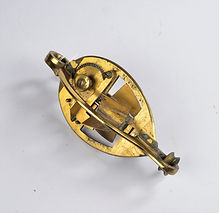
‘Sea-sounding instrument’ based on atmospheric pressure, 1936
Maker:
E. E. Wigzell, London and Glasgow
Collection:
NavigArte
A depth gauge operating on the principle of water pressure: seawater rises inside the instrument as depth increases. Once back on deck, the depth can be read using the calibrated wooden scale.


10.7
Traverse board or pelorus, circa 1750
Maker:
Anonymous, Netherlands
Collection:
NavigArte
Used for recording the compass course and distance sailed during a watch between the 16th and 19th centuries. Every half hour, the helmsman marked the course during the four-hour watch and recorded with a small pen the distance sailed per hour (speed in knots). Afterwards, the estimated position (‘dead reckoning’) was plotted on the chart.

10.8
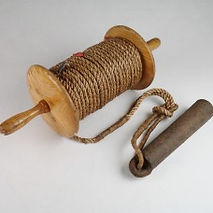
Large reel with (later) hand log, circa 1880
Maker:
Anonymous, Netherlands
Collection:
NavigArte
With the traditional hand log, the ship’s speed was measured using the ‘log chip’ cast astern. The line, knotted at intervals of 14.42 metres, was allowed to run out by hand. When the sailor called ‘stop’ using a sandglass of 28 seconds, the number of knots counted indicated the ship’s speed in ‘knots’ or in ‘nautical miles per hour’ (1.852 km).

10.9
‘Sea meter’ on a tobacco box, 1729
Maker:
Peter Holm, Sweden, Netherlands and Germany
Collection:
NavigArte
Peter Holm, a Swede who ran a navigation school in Amsterdam called ‘Regt door Zee’, had these tobacco boxes manufactured in Iserlohn, Germany. The underside bears a ‘sea meter’: a table converting the run of the log chip into knots. The lid features a perpetual calendar decorated with the heads of Pope Gregory XIII, Julius Caesar, and Amerigo Vespucci.

10.10
Log Sandglasses, Ca. 1800
Maker:
1/ Wooden Anonymous
2/ Brass 14 en 28 sec, Royal Navy, London and Portsmouth
Collection:
NavigArte
To measure a ship’s speed, the log glass was run for either 14 or 28 seconds. Marine sandglasses existed for 14 or 28 seconds (speed measurement) and for 30, 60, or 120 minutes (timekeeping on board).


10.12
Walker’s A1 “Harpoon” Patent Scheepslog Nr. 3380, 1862
Maker:
Thomas Walker, Birmingham
Collection:
NavigArte
From the 19th century onwards, attempts were made to automate speed measurement using mechanical logs. The aft vanes rotated, and the distance travelled could be read from the dial. Patented in 1861.


Our proud sponsors


Partners & sponsors