Display 4: Jacob's staff (cross staff)

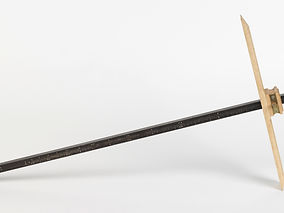
The Jacob's staff, also called the cross staff, is a further development of the Arabic kamal. The instrument was used to measure the altitude of celestial bodies above the horizon and thus determine their latitude. The further north one sailed, the higher the Pole Star was in the sky. Therefore, a longer staff with a sliding crossbar was used, with which one could measure the so-called pole height, or "shoot a sun."
When measuring the sun, the sailor had to look at the horizon and the sun simultaneously, making the instrument dangerous for the eyes. This explains why sailors and pirates are often depicted wearing an eye patch in images: it served to protect one eye and allow it to adjust to the bright sunlight.
Leuven scholar Gemma Frisius experimented with the Jacob's staff to determine even the longitude by measuring the moon's position. In practice, however, this method proved extremely difficult and inaccurate.
Improvements to the Jacob's staff were made by, among others, the Dutch astronomer Metius and later the Antwerp engineer Michiel Coignet. They developed versions with multiple crossbars, allowing for more accurate measurements. Dutch sailors even added an extra plate so the Jacob's staff could be used with the back to the sun, significantly reducing the risk of eye damage.
4.1
Jacob’s Staff, 1739
Maker:
Johannes Van Keulen, Amsterdam
Collection:
NavigArte
Amsterdam (Netherlands). This staff, manufactured in Amsterdam, was originally equipped with four crosspieces. One replica crosspiece has been mounted here. Signed and dated “JvK” and “1739”. To measure the declination of a celestial body, the navigator holds the graduated staff at arm’s length and slides the crosspiece along the scale until the upper end aligns with the celestial body and the lower end with the horizon.
4.2
Petri Apiani Cosmographia, edited by Gemma Frisius
Printed by Arnoldus Birckman in Antwerp, 1540
Maker:
Petrus Apianus en Gemma Frisius, Leuven
Collection:
NavigArte
The Cosmographia was a highly successful popularizing work on astronomy, geography, cartography, surveying, navigation, and scientific instruments.
As early as 1530, in his work De principiis astronomiae et cosmographiae, Frisius mentioned the use of a “portable timekeeper” for determining longitude at sea. In other words, the principle of the marine chronometer was already known in the 16th century. This illustration from the Cosmographia perfectly depicts angular measurement with a simple Jacob’s staff between the Moon and a star, as used in the lunar distance method.

4.3
Astronomische ende geographische onderwysinghe, 1632
Maker:
Adrianus Metius, Franeker
Collection:
NavigArte
Rare edition comprising five parts in a single volume. The Dutch mathematician Adrianus Metius (1571–1635) was professor of mathematics, navigation, astronomy, and surveying at the University of Franeker after working with Tycho Brahe.
Illustration showing the use of a Jacob’s staff with two vanes.

4.4
Nieuwe onderwijsinge op de principaelste puncten der Zeevaert, First Dutch edition, 1580
Maker:
Michiel Coignet, Antwerp
Collection:
NavigArte
The original first Spanish edition of this book dates from 1545. It is the first and one of the most important works on maritime navigation. The book was translated several times, including into Dutch by the Antwerp mathematician Michiel Coignet. In his supplement, Nieuwe onderwijsinge, he describes, among other things, his improved Jacob’s staff with three vanes.


4.6
Replica of a Jacob’s staff made by Gerrit Hasebroek in 1765 (Fries Museum)
2008
Maker:
Cor Emke, Netherlands
Collection:
NavigArte
This facsimile or replica shows, in addition to the three vanes, a fourth vane with a white “bone”, allowing the Jacob’s staff to be used as a backstaff, with the navigator’s back turned toward the Sun.

Our proud sponsors


Partners & sponsors