Display 8: Time measurement and length determination

For centuries, determining longitude was the greatest problem in maritime navigation. Unlike latitude, which could be derived relatively easily from the altitude of the sun or the North Star, longitude required precise timekeeping. At sea, however, reliable timekeeping proved particularly difficult.
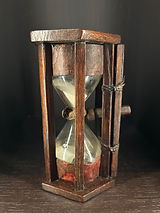
For centuries, sailors used hourglasses to measure fixed time intervals, usually half an hour. Combined with the log, which estimated speed, they could thus approximate the distance traveled and the course. This method, called dead reckoning, was useful but inaccurate and led to significant errors in the estimated position on long voyages.
The fundamental insight that time and longitude are linked was clearly formulated in the 16th century by the Leuven scholar Gemma Frisius. In 1530, he proposed that longitude could be determined by comparing the local time—derived from the position of the sun—with the time at a fixed reference point. Each hour of time difference corresponds to a 15-degree difference in longitude. The problem, however, was that no clock could reliably maintain this reference time during a sea voyage.
Mechanical pendulum clocks were introduced on board ships in the 17th century, among others, by the Dutchman Christiaan Huygens, but they proved too sensitive to shocks, temperature fluctuations, and humidity. Frisius's theoretical insight was sound, but not yet technically feasible.
The breakthrough didn't come until the 18th century with the development of the marine chronometer. English clockmaker John Harrison built a series of highly accurate timepieces that kept their time even at sea. By setting the chronometer to a fixed reference time, such as Greenwich Mean Time, and comparing it with local noon, longitude could finally be reliably determined.
The combination of the chronometer, sextant, and nautical tables made safe, worldwide navigation possible. Thus, an idea already theoretically developed in the 16th century ultimately became the key to modern seafaring.
8.1
Nocturnal, Circa 1640
Maker:
Anonymous, UK
Collection:
NavigArte
This palmwood nocturnal allows the user to read the time at night by aligning the Pole Star with two reference stars from either Ursa Major or Ursa Minor (the ‘pointers of both Bears’). On the reverse side, on display, a correction scale is provided to adjust latitude calculations made using the Pole Star.




9.6
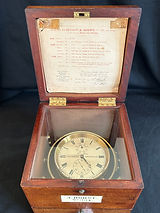
Chronometer of Abraham-Louis Bréguet et Fils nr. 4859, 1830
Maker:
Bréguet et fils. Hgers ( Horloger) de la Marine Royale, Paris
Collection:
NavigArte
An important chronometer by one of France’s finest chronometer makers. This spring-driven chronometer features a single train with an Earnshaw spring-detent escapement mounted on a separate platform, a bimetallic compensation balance with spiral spring, cylindrical balance weights, and adjustment screws, all housed in a brass gimbal-mounted bowl.

8.8
Chronometer E. Dent Nr. 3047 , 1865-70
Maker:
E. Dent & Co “ successors to the late E.I. Dent & F. Dent, London
Collection:
NavigArte
48-hour chronometer with a rare 24-hour (sidereal) dial. Edward Dent was the maker of Big Ben; after his death in 1853, the clock was completed by his son Frederick William Dent, and the company passed to his widow Elizabeth Dent.

8.9
De principiis astronomiae et cosmographiae, (only in the 3th edition of 1553)
Maker:
Gemma Frisius, Leuven
Collection:
NavigArte
In this work, and only in this 3rd edition of 1553, Frisius refers to the use of a ‘portable timekeeper’ for determining longitude at sea. In other words, the principle of the marine chronometer was already known in the 16th century.

8.10
Pendulum clock by Bernard Vander Cloesen, 1690
Maker:
Bernard Vander Cloesen, Den Haag
Collection:
NavigArte
As Gemma Frisius had already concluded, determining longitude required nothing more than an accurate clock. Christiaan Huygens had just invented such a clock with his Hague pendulum clocks fitted with ‘cheeks’. Making them seaworthy proved difficult, however, due to issues such as gimbal suspension. Clocks by Severijn Oosterwijck and Vander Cloesen were tested at sea.

9.11
Opera Varia Christiaan Huygenii, 1724
Maker:
W.J. 's-Gravesande by Vander AA, Leiden
Collection:
NavigArte
First edition of the collected works of Christiaan Huygens, including his most important contributions to mathematics and physics, such as the rings of Saturn, geometry, optics, and his studies on clocks and gimbal-mounted marine timekeepers.

Our proud sponsors


Partners & sponsors