Display 5: Davis Quadrant (Backstaff)

When using the Jacob's staff, sailors risked damaging their eyes by looking directly at the sun. Therefore, Dutch sailors early on experimented with methods that observed the sun through its shadow. The Davis Quadrant came into use, particularly in England and later aboard ships of the Dutch East India Company (VOC). As the English term "backstaff" indicates, this meant that the observer stood with their back to the sun.
The English navigator John Davis (1550–1605) designed the first versions of this instrument, also called the Davis cross. Over the course of the 17th century, the design evolved into the Davis quadrant shown here, which was in common use by the middle of that century.
The Davis quadrant consists of two protractors: a small arc with 60° graduations and a larger arc with 30° graduations. Around local noon, the user would look through the viewing sight on the large arc, via the horizon sight, at the horizon. Simultaneously, the sun's shadow, which was behind the observer, would fall on the horizon sight via the shadow sight. The two angle readings were added together to give the measured solar altitude.
After applying corrections—for the observer's altitude above the sea, atmospheric refraction, and the semi-diameter of the sun—solar declination was subtracted. This was usually indicated on the back of the great arc. This allowed for a quick and relatively accurate determination of the latitude based on the sun's noontime altitude.
The Davis Quadrant was not suitable for observing stars or planets. Moreover, the instrument could only be used when the sun was bright enough to cast a clear shadow.
5.1
Davis quadrant or Backstaff, 1730
Maker:
John Dobson, London
Collection:
NavigArte
Although already described in 1595 by John Davis, the backstaff or Davis quadrant only came into widespread use from around 1680, more so in England than in the Netherlands. It is a shadow instrument that allowed the navigator to observe the Sun without looking directly at it, thus avoiding eye damage.
The measured angle on the small 60° arc had to be added to the measured angle on the larger 30° arc.

5.2
Nouvelle carte pour conduire à la connoissance de la marine et à demontrer la plus ârt des instruments, 1720
Maker:
L’Honore & Chatelain, Amsterdam
Collection:
NavigArte
Copper engraving illustrating the instruments used on board ships around 1720: the compass, the sector, the nocturnal, the Jacob’s staff, the backstaff, and the reflecting arc.

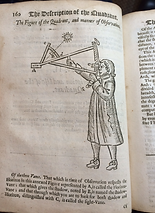
5.4
Davis Quadrant or Backstaff, 1736
Maker:
William Clarke, London
Collection:
NavigArte
On the large 30° arc there is a fiducial scale, while the reverse side bears the Sun’s declination table. The graduation on the small 60° arc runs from 0° to 60°, marked at every degree. Along the outer edge an additional scale is provided for correction of the Sun’s semi-diameter.

Our proud sponsors


Partners & sponsors